しばらく忙しくてブログの更新ができませんでした。3月に日本農薬学会大会で発表予定の研究データの解析に加えて、急遽NHKの解説員室を明日訪問して、最近の冷凍食品への殺虫剤混入事件に関連して「農薬/殺虫剤/マラチオン/毒性に関する基礎知識」について情報提供することになりましたので、その資料の準備にも追われていました。やっと資料の準備が終わりました。
アメリカの友人から今回の事件について、アメリカでネットで配信されている情報を送ってきました。日本で起こった事件なので、英語でどのように報道されているかわかります。
・・・・・・・・・・・・・・・・・・・・・・・・・・・・・・・・・・・・・・・・・・・・・・・・・・・・・・・・・・・
FOOD POISONING - JAPAN: MALATHION
*********************************
A ProMED-mail post
<http://www.promedmail.org>
ProMED-mail is a program of the
International Society for Infectious Diseases <http://www.isid.org>
[1]
Date: Wed 8 Jan 2014
Source: BBC News [edited]
<http://www.bbc.co.uk/news/world-asia-25635139>
Hundreds of people in Japan say they have fallen ill after eating frozen
food that may have been contaminated with pesticide. Maruha Nichiro Holdings
announced last week [week of 30 Dec 2013] that it was recalling products
after some were found to contain high levels of malathion.
The Health Ministry said at least 556 people had reported symptoms like
diarrhoea, vomiting and stomach pain. The pesticide is used in farming,
gardening and for killing fleas.
It was not immediately clear exactly how many people were affected.
Public broadcaster NHK World on Wednesday [8 Jan 2014] said almost 900
people had reported symptoms after eating the products, which included pizza
and chicken nuggets.
Maruha, which has received hundreds of thousands of phone complaints, issued
a public apology in newspapers on Wednesday. It is recalling at least 6.4
million food packages manufactured at a factory in Gunma prefecture, north
of Tokyo. It started the food recall last week, recovering more than one
million packages so far.
"The products will have a strong smell, and eating them may cause vomiting
and stomach pain," Maruha said in a notice to consumers. The cause of the
contamination has not yet been determined.
--
Communicated by:
ProMED-mail
<promed@promedmail.org>
******
[2]
Date: Wed 8 Jan 2014
Source: Mainichi [edited]
<http://mainichi.jp/english/english/newsselect/news/20140108p2a00m0na006000c
.html>
A subsidiary of a major processed food company that found pesticide residue
in its frozen food products suspects the goods were laced with the chemical
at several different times at the company's factory in Gunma Prefecture,
company officials said.
Aqli Foods Co., a subsidiary of processed food giant Maruha Nichiro Holdings
Inc., detected malathion, an organic phosphate typically used as a
pesticide, in 9 samples from 7 different packages of pizza, fried foods and
croquette products, which had been manufactured between 4 Oct and 5 Nov
2013.
The company revealed to the Mainichi Shimbun on 7 Jan 2014 that its frozen
products are normally kept in interim storage freezers at the factory for 1
to 2 weeks after they are packaged. As there is a 1-month gap in the
manufacturing dates of the contaminated products, Gunma Prefectural Police
and the company suspect that the products had been tainted at several
different times during that period.
According to the company, its frozen foods are processed and frozen in
separate rooms for each product line and sent along the packaging process.
There are some 80 employees working shifts in the packaging room.
After packaging, the products are kept in freezers for 1 to 2 weeks and
distributed across the country from warehouses in Saitama and Kanagawa
prefectures.
The Gunma Prefectural Government has concluded that it is unlikely for the
pesticide to have entered into the products during the distribution process
or that pre-processed raw materials contained the chemical. Prefectural
police and other investigative sources suspect that the products may have
been contaminated intentionally in the factory's packaging room several
times between 4 Oct and 5 Nov 2013.
According to a male worker at the factory, there are guards at night and the
freezers are locked every night after factory operations end at 10:00 p.m.
He said it's impossible to sneak into the freezer outside of operation
hours. Company officials refused to comment on the possibility that the food
products had been contaminated more than once at the factory, saying they
can't comment on matters relating to the investigation.
--
Communicated by:
Mark Liao
<markliaohk@gmail.com>
******
[3]
Date: Thu 9 Jan 2014
Source: The Japan Times [edited]
<http://www.japantimes.co.jp/news/2014/01/09/national/over-1000-sickened-by-
tainted-food>
More than 1000 people nationwide have fallen sick after eating frozen food
tainted with pesticide made by Aqlifoods Corp., according to local
government and other officials. The food, made by the unit of Maruha Nichiro
Holdings Inc. at a plant in Oizumi, Gunma Prefecture, has caused fever,
dizziness and stomachache as well as vomiting and diarrhea. Police suspect
that malathion, an insecticide, may have been purposefully injected into the
products.
A particularly high number of people, over 200, have been affected in
Hokkaido [Prefecture]. More than 100 people have been sickened in Chiba
Prefecture, while over 60 have fallen ill in both Niigata and Shizuoka
prefectures.
In Osaka Prefecture, where nearly 50 have been affected, including a
9-month-old boy who was hospitalized Monday [6 Jan 2014] after eating the
creamed corn filling of a frozen croquette on [29 Dec 2013]. Of all the
tainted food products, the highest concentrations of malathion have been
detected in croquettes.
A 5-year-old boy in Sendai [Miyagi Prefecture] was hospitalized for 3 days
after eating pizza on [20 Oct 2013]. It is believed the pizza was among the
products being recalled for suspected malathion contamination. Also in
Sendai, an 8-year-old girl was hospitalized for
3 days after eating a "cream korokke" (croquette) on [21 Dec 2013]. A man in
his 30s in Aomori Prefecture, and another man in Kanagawa Prefecture, were
also hospitalized with symptoms including numbness in the limbs.
Maruha Nichiro said Tuesday [7 Jan 2014] it collected 1.49 million packs of
frozen foods by Monday [6 Jan 2014], 23 percent of 6.4 million packs subject
to the recall. Of the total called back, 1.43 million packs were collected
from supermarkets and others, while consumers returned nearly 60 000 packs.
--
Communicated by:
Mark Liao
<markliaohk@gmail.com>
[Malathion is a manmade organophosphate chemical with many uses, generally
used as an insecticide. While it is a strong chemical and comes with
warnings, and while dose always makes the poison, it is nevertheless
regarded as having a relatively low toxicity to humans.
It is, however, relatively toxic to rodents.
Malathion is commonly used to control mosquitoes and a variety of insects
that attack fruits, vegetables, landscaping plants, and shrubs. It can also
be found in other pesticide products used indoors and on pets to control
ticks and insects, such as fleas and ants.
Malathion is the active ingredient in mosquito control products, including
Fyfanon and Atrapa. These products contain over 95 percent malathion and are
often applied undiluted. However, they may be diluted with a petroleum
solvent similar to kerosene before application, in which case petroleum
solvent will make up most of the pesticide solution. Malathion has also been
used to control and eradicate head lice in people.
Short-term exposures to high levels of malathion can affect the nervous
system, causing a variety of symptoms, including headaches, nausea,
dizziness, weakness, cramps, diarrhea, excessive sweating, blurred vision
and increased heart rate. Repeated skin contact with malathion has been
associated with skin rash (allergic reaction) in some individuals exposed to
malathion in corn syrup bait. Short-term exposure to high levels of
petroleum solvents can cause irritation of the eye, skin, nose, throat or
lung. Vomiting or central nervous system depression may occur if very high
levels of petroleum solvents are ingested. There are no studies examining
whether the use of malathion to control mosquitoes has caused any long-term
health effects in humans.
Human volunteers fed very low doses of malathion for one and a half months
showed no significant effects on blood cholinesterase activity.
Rats fed diets containing 100-1500 ppm of malathion in their food for
2 years showed no symptoms apart from depressed cholinesterase activity.
When small amounts of the compound were administered for 8 weeks, there were
no adverse effects on rats' whole-blood cholinesterase activity. Weanling
male rats were twice as susceptible to malathion as adults.
Malathion is classified as slightly toxic and carries the signal word
"caution" on the label. The acute effects of malathion depend on product
purity and the vehicle of administration. Thus the LD50 (median lethal dose)
for rats ranges from 480 to 10 700 mg/kg and from
775 to 3321 mg/kg for mice. Several other factors also affect the toxicity
of the pesticide. For example, the toxicity of malathion appeared to be
strongly linked to the amount of protein in the diet of laboratory rats. As
protein intake decreased, malathion was increasingly toxic to the rats.
Malathion has been shown to have different toxicities in male and female
rats and humans due to metabolism, storage and excretion differences between
the sexes. For humans, the lowest dose at which lethal effects have been
observed was nearly 3 times higher for males than for females. Acute
symptoms in humans include nausea, headache, tightness in the chest, and
other symptoms typical of acetyl- cholinesterase inhibition.
Unconsciousness, convulsions, and a "prolonged worsening illness" are also
typical of malathion poisoning at high doses.
The people experiencing illnesses originally reported the illnesses as
resulting from the smell. Now it appears there may be some ingestion of the
tainted product.
An investigation as to how the variety of products became contaminated, who
did this contamination, how they accomplished it and how many more packages
are tainted is likely to take a while. The investigation should result in
changes that will result in a more secure processing plant.
Japan may be located on the HealthMap/ProMED-mail interactive map at:
< http://healthmap.org/r/62Cn >. -Mod.TG]
・・・・・・・・・・・・・・・・・・・・・・・・・・・・・・・・・・・・・・・・・・・・・・・・・・・・・・・・・
2014年1月11日土曜日
今日も時間が惜しかったけど、無理して約2時間外に出て歩いたり走ったりしてきました。久し振りに河口(東京湾)に向かって左岸の江戸川堤防を行ってみました。土曜日だったので、矢切の渡しには大勢の乗船者がいて、東京側から渡ってきた人たちは堤防上の案内の看板を見ながら目的地を探していました。斜面林までの広大な農地には、有名な矢切のネギの畑がたくさんありますが、農家の夫婦が収穫をしていました。妻に訊いたら今はネギの値段が高く、1本100円くらいするとのことでした。
昨年10月に訪ねた中国では、棚田のある元陽県の地方都市では少数民族の姿をよく見かけました。少数民族の女性は頭にかぶったスカーフと「前掛け」を体の後ろ側にかけたような「後ろ掛け」のデザインで区別がつくのだそうです。道路は、近代的な車と、三輪自動車と、オートバイと、歩行者が共用していました。熱帯のベトナムに近いせいか、道路際の商店には熱帯の果物がたくさん並んでいました。


昨年10月に訪ねた中国では、棚田のある元陽県の地方都市では少数民族の姿をよく見かけました。少数民族の女性は頭にかぶったスカーフと「前掛け」を体の後ろ側にかけたような「後ろ掛け」のデザインで区別がつくのだそうです。道路は、近代的な車と、三輪自動車と、オートバイと、歩行者が共用していました。熱帯のベトナムに近いせいか、道路際の商店には熱帯の果物がたくさん並んでいました。

データの計算や解析に追われていて時間が惜しい気がしましたが、運動のために外に出て、水元公園の桜堤(つづみ)のジョギングコース(遊歩道)を「カワセミの里」まで往復8km ちょっと歩いたり走ったりしてきました。北風が強く吹いて寒い日でしたが、何人かの熱心なカメラマンが望遠レンズを付けたカメラを三脚に固定して、カワセミが水辺に現れるのをじっと待っていました。私もしばらく立ち止まって見ていたら、幸運にも一羽飛んできたのでポケットに入れて持参したカメラのシャッターを押しました。
雲南省では棚田を見に行く前に小さな町で一泊して、昼食を食べました。昆虫がお皿にでてきたのにはちょっとビックリしましたが、地元の人たちと同じように私も普通の顔をして食べました。名前は訊き忘れましたが、竹に寄生している害虫だそうです。夜は屋台で通りが一杯になり、人も大勢でて賑わっていました。ガイドとして付き添ってくれた中国の人たちと一緒に屋台で一杯やりました。


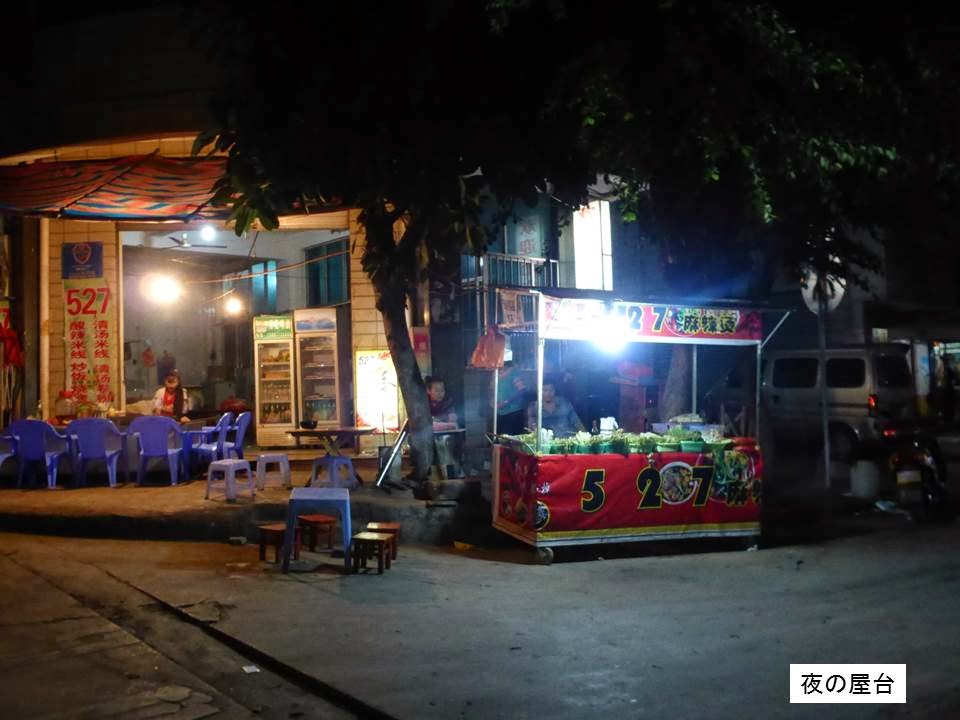


雲南省では棚田を見に行く前に小さな町で一泊して、昼食を食べました。昆虫がお皿にでてきたのにはちょっとビックリしましたが、地元の人たちと同じように私も普通の顔をして食べました。名前は訊き忘れましたが、竹に寄生している害虫だそうです。夜は屋台で通りが一杯になり、人も大勢でて賑わっていました。ガイドとして付き添ってくれた中国の人たちと一緒に屋台で一杯やりました。
登録:
投稿 (Atom)